
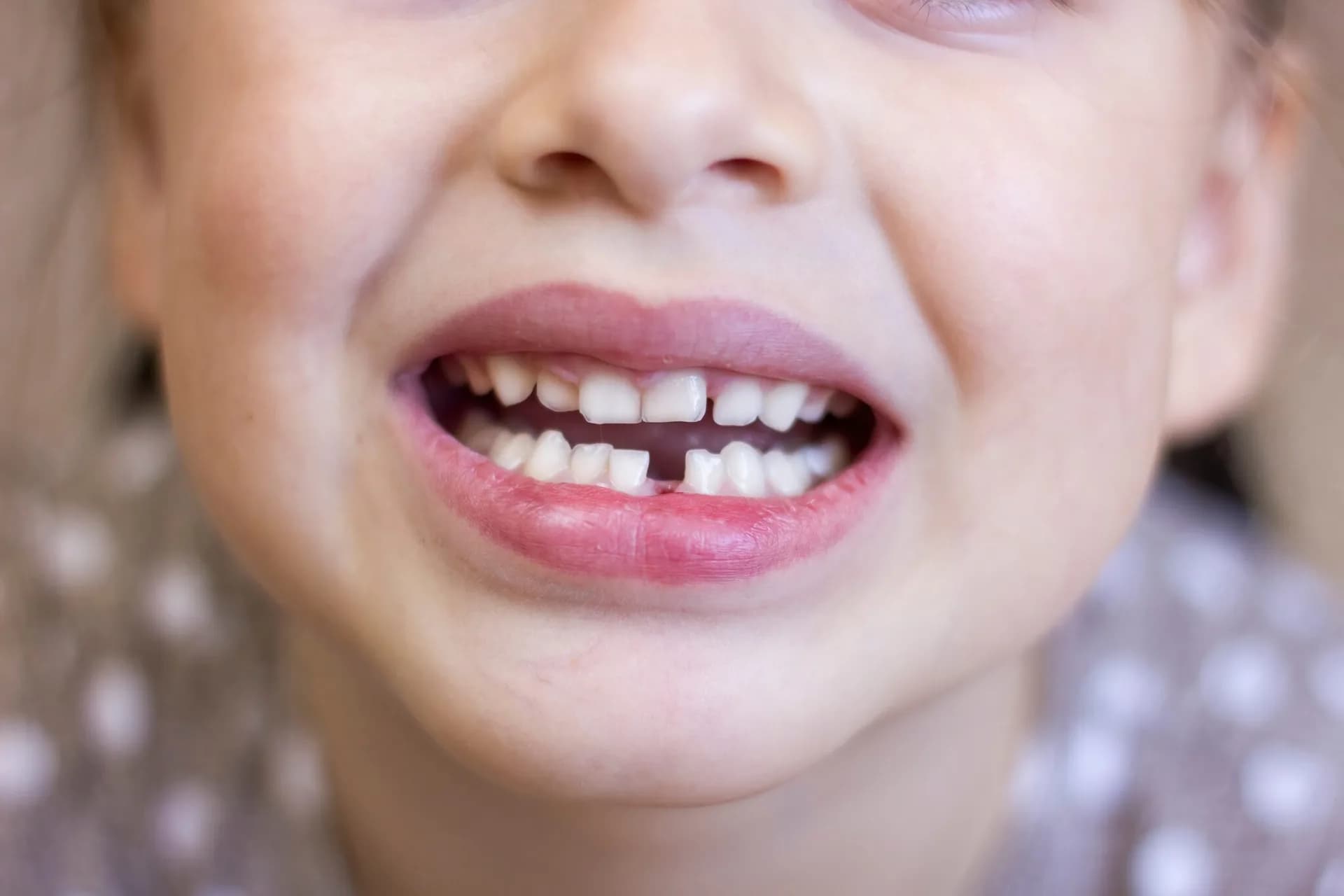
When a baby tooth is lost too early, although not in every child, the surrounding teeth may drift into the gap. The space in which the permanent tooth waiting underneath will come through can become narrower. A space maintainer for children is an appliance used to monitor or reduce this risk.
In this article we explain what a space maintainer is, its types and the situations in which it is considered. Whether a space maintainer is needed can only be decided by a dentist after examining the child.
What is a space maintainer for children?
A space maintainer is a small appliance made to preserve the gap left by a baby tooth lost early. Its purpose is to limit the drifting of neighbouring teeth into the gap and to leave room for the permanent tooth developing underneath.
Baby teeth are important not only for chewing and speech but also because they guide the permanent teeth. For this reason, the state of the gap is assessed after an early loss.
Illustrative image
What happens if a baby tooth is extracted early?
When a baby tooth is lost early because of decay, infection or trauma, the following may be seen:
Neighbouring teeth drifting towards the gap
Narrowing of the space reserved for the permanent tooth
The permanent tooth coming through in a different direction or with a lack of space
The way the upper and lower teeth meet being affected
Not all of these occur in every child. The risk varies according to the type of tooth lost, the child's age and how close the permanent tooth is. In some children, regular check-ups alone may be recommended instead of a space maintainer.
What happens if a baby tooth is lost early?
When is a space maintainer needed?
When deciding, the dentist generally looks at:
Which baby tooth was lost, and when
The development and eruption time of the permanent tooth
The width of the existing gap and the position of the neighbouring teeth
X-ray findings, if needed
Without this assessment, it would not be right to say it "should" or "should not" be fitted.
What types of space maintainers are there for children?
Space maintainers fall into two main groups. The dentist decides which is suitable according to the child's age, the number of missing teeth and their position in the jaw.
Fixed space maintainers
They are cemented in the mouth by the dentist and the child cannot remove them. Commonly used types include:
Band and loop: An appliance attached to a neighbouring tooth that preserves the gap when a single baby molar has been lost.
Lingual arch: An appliance that can be used to preserve space for more than one tooth in the lower jaw.
Nance appliance: Used in selected cases in the upper jaw to maintain the position of the back teeth.
Distal shoe: A special type used in selected cases where the second baby molar is lost before the permanent first molar has come through.
Removable space maintainers
They are made to the child's mouth measurements and can be taken out and put back in. They are mostly considered when more than one tooth is missing. Because they require regular use, cooperation from the child and the family is important.
Illustrative image
At what age is a space maintainer fitted in children?
There is no fixed age for a space maintainer. What matters is the age at which the tooth was lost and how much time remains before the permanent tooth comes through.
For example, in a child who loses a baby molar at age 5, it may be years before the permanent tooth comes through. In this case, preserving the gap may be more important. For a child who loses the same tooth at an age when the permanent tooth is about to come through, a different approach is usually followed.
How is a space maintainer fitted in children?
1. Examination: The lost tooth, the gap and the neighbouring teeth are examined.
2. Imaging: If considered necessary, an X-ray is taken to show the position of the permanent tooth.
3. Choice of appliance: A fixed or removable option is chosen.
4. Fitting: An impression or digital scan is taken, and the appliance is prepared and placed in the mouth.
5. Follow-up: The family is given information about care, and check-ups are planned.
During fitting or in the first few days, while the child is getting used to the appliance, they may feel slight pressure or an unfamiliar sensation. If there is ongoing discomfort, a gum sore or the appliance breaks, the dentist should be contacted.
How long is a space maintainer used for?
The duration varies from child to child. It is intended to be used until the permanent tooth comes through. At check-ups the dentist monitors the eruption of the permanent tooth and decides when the appliance will be removed.
Regular check-ups help monitor baby tooth loss and the gap.
What should be kept in mind while using a space maintainer?
Teeth should be brushed twice a day, and the area around the appliance should be cleaned carefully.
The dentist's recommendations about sticky and hard foods should be followed.
Removable appliances should be worn and cleaned as the dentist describes.
If the appliance becomes loose, breaks or causes a sore, the dentist should be seen without delay.
Check-up appointments should not be missed.
What happens if a space maintainer is not fitted?
In a child who needs a space maintainer, the gap may narrow over time and the permanent tooth may come through with a lack of space. In this case, orthodontic treatment may be needed later. However, this risk is not the same with every tooth loss. This is why having the child examined after an early loss is enough for the right decision to be made.